

Many health plans include substance use disorder benefits, but detox coverage depends on the specific plan, provider network, authorization rules, recommended level of care, and services billed. Verify benefits before admission when possible, and ask which answers are estimates rather than guarantees of payment.
- 1Substance use disorder coverage does not mean every detox provider or service is covered the same way.
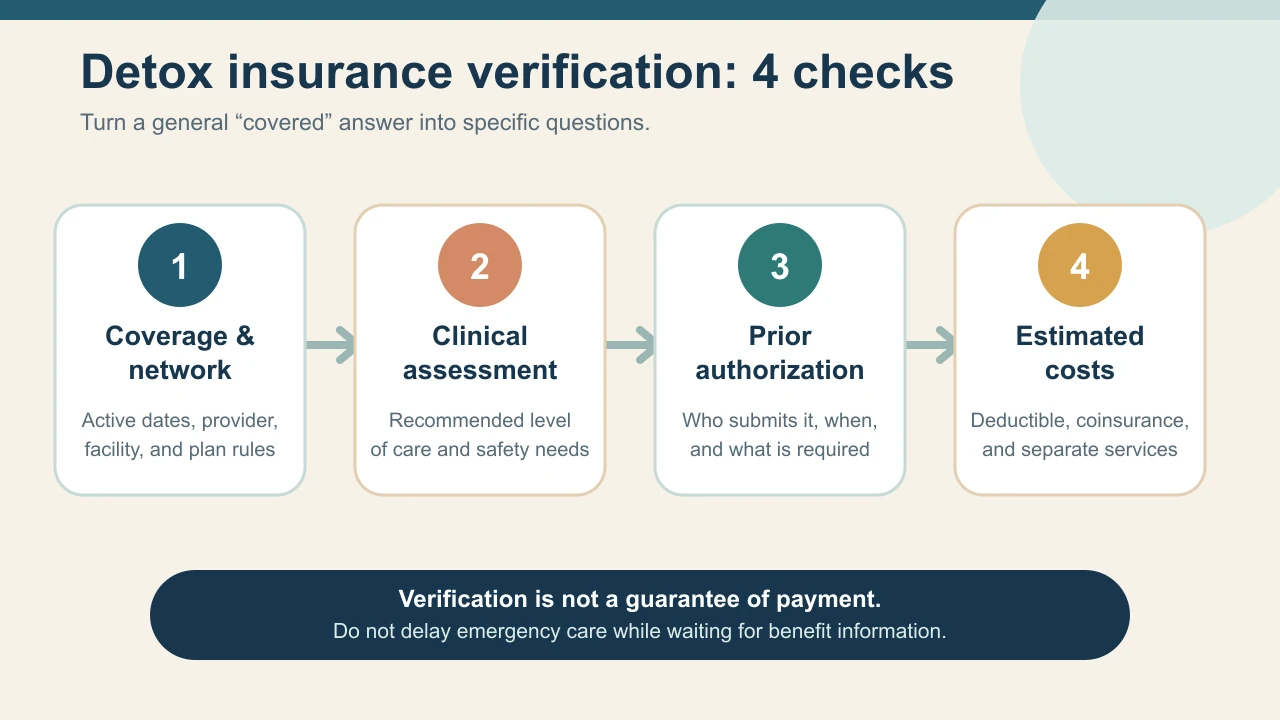
- 2Confirm active coverage, network status, authorization, and the recommended level of care.
- 3Ask whether medications, laboratory work, professional fees, and transportation are billed separately.
- 4Do not delay emergency care because insurance information is incomplete.
People searching for detox with insurance in Huntington Beach often want a yes-or-no answer. The more accurate answer is that many health plans include substance use disorder treatment benefits, but coverage for a particular detox admission depends on the plan, provider, network, authorization rules, recommended level of care, and services billed.
A good verification call should make those variables easier to understand without presenting an estimate as a guarantee.
For a non-emergency next step, use Surf City’s insurance verification form to request a benefits review, or read the admissions assessment and arrival steps. Coverage information does not establish clinical fit, acceptance or a start date.
Start With Active Coverage and Network Status
HealthCare.gov explains that Marketplace plans include mental health and substance use disorder services as essential health benefits. Specific benefits still vary, and other employer, individual, Medicare, or Medicaid plans follow their own rules.
Ask:
- Is the policy active on the expected admission date?
- Is the detox provider in-network?
- Are individual clinicians or facilities billed separately?
- Does the plan offer out-of-network benefits?
- Which deductible and out-of-pocket amounts have already been met?
Record the date, representative, and reference number when available.
Confirm the Recommended Level of Care
Insurance coverage is often connected to the level of care that a qualified professional recommends. The plan may require clinical information or prior authorization before approving withdrawal management or another service.
Ask the detox program and insurer:
- What assessment is required?
- Is prior authorization needed?
- Who submits the clinical information?
- How long does an initial authorization cover?
- How are additional days reviewed?
- What happens if a different level of care is recommended?
Insurance verification does not replace a medical or clinical assessment.
Ask What Is Included in the Estimate
A general statement that “detox is covered” may not explain every possible charge. Ask whether the estimate addresses:
- Facility services
- Medical or professional fees
- Medications
- Laboratory testing
- Transportation
- Emergency services
- Room or program upgrades
- Follow-up treatment after detox
Request written benefit information when possible. If an item cannot be confirmed, label it as unresolved rather than assuming it is included.
Understand Authorization and Medical Necessity
HealthCare.gov defines preauthorization as an insurer’s medical-necessity decision that may be required before certain services, except in an emergency. Prior authorization is not a promise that the plan will pay for the service.
Ask:
- Who is responsible for obtaining authorization?
- Is authorization required before arrival?
- Does the plan require use of a particular facility?
- What documentation is needed?
- How can an adverse decision be appealed?
- Is there a separate review for residential treatment after detox?
Do not rely only on a verbal statement that no authorization is needed. Ask the insurer to identify the applicable rule or call reference number.
Do Not Delay Emergency Care for a Benefits Call
Some withdrawal situations can become medically dangerous. NIAAA notes that alcohol withdrawal can include seizures or delirium and that some people need intensive medical monitoring.
If someone is experiencing a seizure, severe confusion, trouble breathing, loss of consciousness, suspected overdose, or another immediate danger, call 911 or seek emergency care. Insurance questions can be addressed after urgent safety needs.
Ask About the Plan After Detox
Detox addresses withdrawal and medical stabilization; it is not the whole treatment plan. Ask what services may follow and whether they require a separate benefit review or authorization.
Possible next steps may include residential treatment, outpatient care, medication follow-up, therapy, or community support. The appropriate recommendation depends on the individual assessment.
Before discharge or transition, ask:
- Which next service is recommended?
- Is it in the same network?
- Does it require new authorization?
- Will transportation or medications change?
- Who schedules the first follow-up appointment?
Bring This Verification Checklist
- Member ID and active coverage dates
- Provider and facility network status
- Recommended level of care
- Prior-authorization requirements
- Deductible, coinsurance, and out-of-pocket information
- Services that may be billed separately
- Unconfirmed items and follow-up owner
- Reference number and date of the call
Use Surf City's insurance information or call (888) 222-1506 for current Huntington Beach admissions and benefit-verification information. Review the admissions process, then confirm the recommended care, acceptance, location and arrival arrangements before making plans.
This article is for educational purposes only and is not medical, insurance, financial, or legal advice. Benefits vary by plan, and verification is not a guarantee of payment. If someone may be in immediate danger, call 911 or seek emergency care.
Frequently Asked Questions
Does health insurance cover detox?
Many plans include substance use disorder treatment benefits, but actual coverage depends on the plan, network, authorization requirements, clinical recommendation, and services provided.
Is insurance verification a guarantee of payment?
No. Verification summarizes available benefit information and estimates. Final payment depends on eligibility, authorization, medical-necessity review, coding, claims processing, and plan rules.
How can I verify benefits with Surf City?
Use Surf City's insurance page or call (888) 222-1506 and ask what information is needed for a benefit review. Confirm any coverage and cost estimates with your insurer.
Sources & References
References used for this article.
- Mental Health and Substance Abuse Health Coverage Options — HealthCare.gov
- Preauthorization — HealthCare.gov
- Alcohol Use Disorder: From Risk to Diagnosis to Recovery — National Institute on Alcohol Abuse and Alcoholism
Amity Surf City Detox